
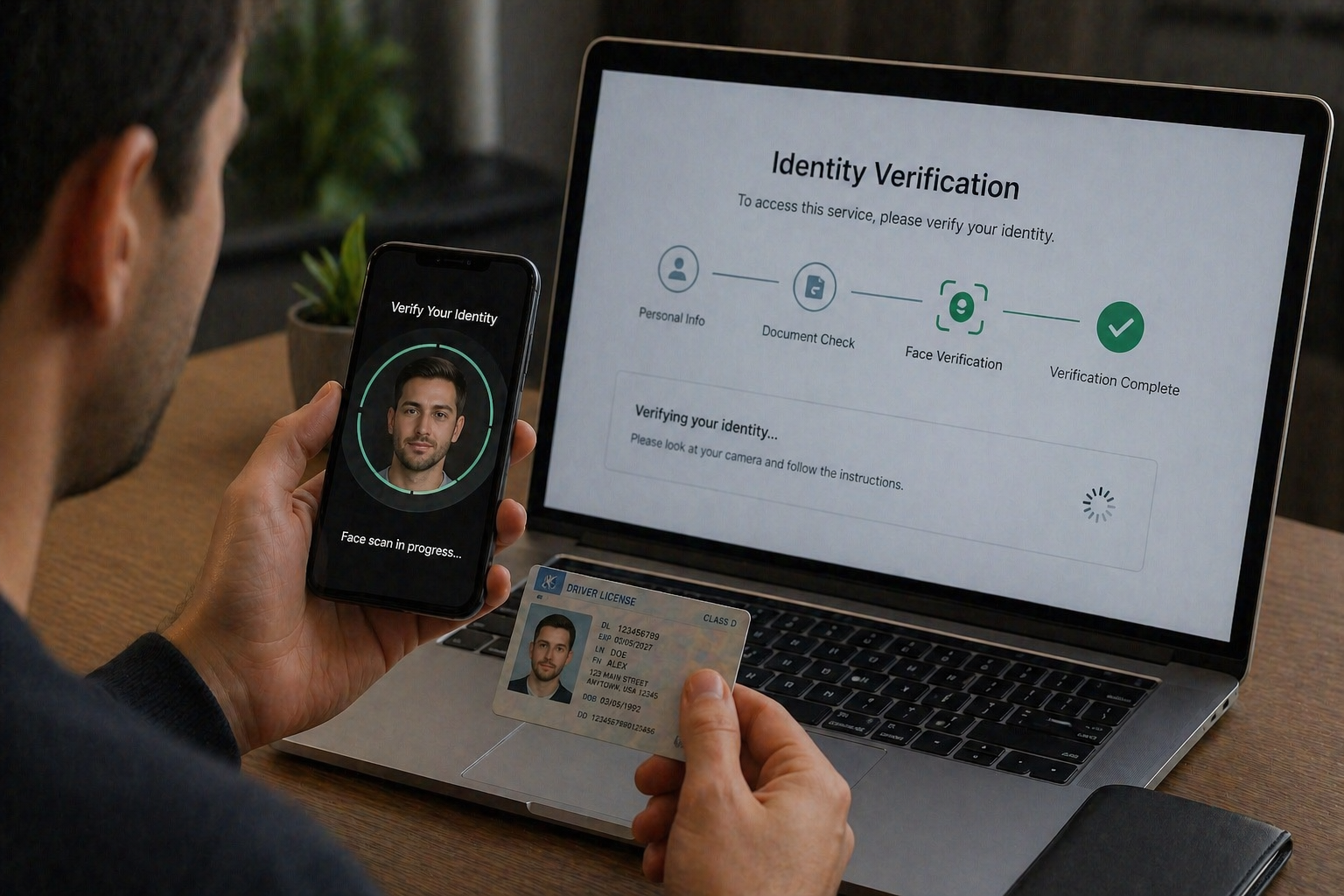
In an era where a person can open a bank account, apply for a loan, or access sensitive government services entirely online, the question of whether someone is genuinely who they claim to be has never been more consequential. Identity fraud is rising. Regulatory expectations are tightening. And the technologies designed to address both have evolved from simple document scans into sophisticated, AI-driven systems capable of detecting a fake ID within seconds.
Identity verification often abbreviated to IDV, sits at the intersection of technology, regulation, and trust. Whether you are a business onboarding new customers, a financial institution managing risk, or simply a consumer wondering why you are being asked to upload your passport to a website, understanding how identity verification works and why it has become so central to modern digital life is increasingly essential.
This article offers a thorough, accessible guide to the field: what identity verification is, why it matters, how it works in practice, where it is being applied, and what the regulatory landscape looks like in the UK and beyond.
What Is Identity Verification?
Identity verification is the process of confirming that a person is genuinely who they claim to be. In a face-to-face context, this has always been straightforward: a bank cashier checks your driving licence, a bouncer glances at your passport. The challenge online is replicating that level of confidence without the physical interaction.
A modern digital identity verification system does this by combining document authentication, biometric analysis, and database cross-referencing into a single automated flow. When a user submits an identity document, a passport, a driving licence, or a national identity card, the system analyses the document for authenticity, extracts the data encoded within it, and compares that data against the person submitting it using facial recognition.
The output is a verification decision: confirmed, referred for manual review, or declined. The whole process, in well-designed implementations, takes under two minutes for the end user.
It is worth distinguishing identity verification from identity authentication. Verification is a one-time or periodic process of establishing who someone is. Authentication is the ongoing process of confirming that the same person is accessing an account through passwords, biometrics, or multi-factor methods. Both matter for security, but identity verification is the foundation upon which everything else is built.
Why Identity Verification Matters
The Scale of Identity Fraud in the UK
The case for robust identity verification services begins with the scale of the problem they are designed to address. In the United Kingdom, identity fraud is the most commonly reported type of fraud, accounting for a significant proportion of all fraud cases reported to Cifas, the UK’s leading fraud prevention service. In 2023 alone, Cifas recorded over 237,000 cases of identity fraud, a figure that has been growing year on year as more activity moves online.
The financial losses are substantial, but the human cost is equally significant. Victims of identity fraud can spend months, sometimes years, untangling the consequences: correcting credit records, disputing fraudulent accounts, and managing the reputational and psychological toll that follows from having one’s identity stolen and misused.
Why Fake ID Remains a Persistent Problem
The use of a fake ID is not a new phenomenon. What has changed is the sophistication with which false identities can be constructed and the scale at which they can be deployed. AI-generated identity documents, digitally altered photographs, and stolen personal data available on dark web marketplaces have made it far easier for bad actors to defeat simple verification checks.
Traditional methods, such as a human reviewing a scanned document or a basic automated check of document formatting, are increasingly insufficient against this threat. A fake ID produced with modern tools can be visually indistinguishable from a genuine document without the kind of multi-layer analysis that advanced identity verification software provides.
Building the Trust That Digital Commerce Requires
Beyond fraud prevention, identity verification matters because digital commerce and services fundamentally depend on trust. When a business cannot confirm who it is dealing with, it cannot accurately assess risk, cannot fulfil regulatory obligations, and cannot protect its customers from harm. The financial services sector has understood this for decades. Increasingly, so do sectors ranging from healthcare and legal services to gaming, cryptocurrency, and online marketplaces.
How Identity Verification Works
Understanding the technology behind a modern identity verification solution helps demystify what can seem like a complex process. At its core, the process follows a consistent sequence of steps, though the sophistication of each varies significantly between providers.
Document Capture and Submission: The user is prompted to photograph or scan a government-issued identity document. Most modern systems support this via a smartphone camera, with real-time guidance to ensure the document is captured clearly, without glare or obstruction. Some providers also support NFC-based reading of the chips embedded in biometric passports, which provides a higher level of assurance.
Document Authentication: The system analyses the submitted document for indicators of tampering or forgery. This includes checking security features, holograms, ultraviolet patterns, machine-readable zones (MRZ), and microprint against known templates for that document type and issuing country. AI models trained on millions of genuine and fraudulent documents power this stage, and they are capable of identifying inconsistencies that would be invisible to a human reviewer.
Biometric Matching: The user submits a selfie or short video clip. Facial recognition algorithms compare the face captured in real time against the photograph on the identity document. The comparison assesses a range of geometric and textural data points to produce a confidence score.
Liveness Detection: This is a critical and often underappreciated step. Liveness detection confirms that the person submitting the biometric is physically present, not submitting a photograph, a mask, or a deepfake video. Passive liveness analysis can achieve this without requiring the user to perform any specific action, while active liveness prompts the user to blink, turn their head, or smile. The most advanced providers hold independent certifications for liveness detection quality, such as iBeta Level 1 and Level 2.
Database Cross-Referencing: Depending on the platform’s requirements and the applicable regulation, the verified identity may be checked against additional databases: sanctions lists, politically exposed persons (PEP) registers, or age verification registries.
Decision and Integration: The verification result is returned to the platform, typically via an Identity Verification API that integrates directly into the company’s onboarding or account management system. This API-based architecture means businesses do not need to rebuild their core infrastructure to implement verification; they connect to a specialist provider and receive results programmatically.
Use Cases Across Industries
The applications of ID verification span virtually every sector of the modern economy where digital onboarding or access control is required.
Financial Services: Banks, lenders, payment providers, and investment platforms are the most established adopters of identity verification. Know Your Customer (KYC) obligations under UK and EU law require financial institutions to verify customer identity before establishing a relationship. This is not optional; failure to comply carries significant regulatory and financial penalties.
Cryptocurrency: and Digital Assets Cryptocurrency exchanges and digital asset platforms face the same KYC obligations as traditional financial services. The integration of crypto into mainstream finance has accelerated regulatory scrutiny, and compliant platforms are expected to implement the same standard of verification as their traditional counterparts.
Healthcare Patient: Identity verification is critical for protecting sensitive medical records, preventing fraudulent prescriptions, and ensuring that telehealth consultations are with the registered patient. As remote healthcare expands, so does the importance of reliable digital identity confirmation.
Online Marketplaces and the Gig Economy: Platforms connecting buyers and sellers, or workers and clients, increasingly verify the identities of participants to reduce fraud, build user trust, and fulfil legal obligations where regulated services are involved. Ride-hailing platforms, freelance marketplaces, and peer-to-peer rental services have all moved in this direction.
Age-Restricted Content and Services: Whether it is alcohol retail, gambling, or adult content platforms, age verification is a legal and ethical imperative. A credible ID verification solution, one that confirms age from actual identity documents rather than self-declaration, is the only reliable way to meet the standard now expected by regulators and the public.
Legal and Professional Services: Solicitors, accountants, and estate agents in the UK are subject to anti-money laundering (AML) regulations requiring them to verify client identity. The shift to remote working and digital client relationships has accelerated the adoption of digital verification tools in these sectors.
The Regulatory Landscape in the UK
The regulatory case for identity verification is substantial and growing. In the United Kingdom, the Financial Conduct Authority (FCA) is the primary regulator for financial services and has long mandated customer identity verification as part of its KYC and AML frameworks. Firms regulated by the Financial Conduct Authority that fail to implement adequate verification procedures face enforcement action, financial penalties, and in serious cases, loss of their operating licence.
Beyond the FCA, the UK’s broader regulatory landscape reflects a growing expectation that digital platforms take identity seriously. The Online Safety Act introduces requirements around age assurance for platforms hosting age-restricted content. The Fifth and Sixth Anti-Money Laundering Directives (5AMLD/6AMLD), which the UK incorporated before Brexit and continues to reflect in domestic legislation, set out clear standards for identity verification in financial and professional services.
At the international level, the Financial Action Task Force (FATF), the global standard-setter for AML and counter-terrorism financing, provides guidance that shapes regulatory frameworks in over 200 jurisdictions. The FATF’s risk-based approach to KYC has become the baseline expectation for financial institutions worldwide, and the identity verification technology sector has developed in direct response to those standards.
The direction of travel is clear. Across jurisdictions, regulators are moving from broad principles toward specific technical requirements. Platforms and businesses that have invested in credible identity verification services are well-positioned; those relying on outdated or superficial checks face increasing exposure.
Business Adoption: From Compliance Checkbox to Competitive Advantage
For much of its history, identity verification was viewed primarily as a compliance burden — a cost of operating in regulated sectors. That perception has shifted considerably. Businesses that implement a capable identity verification platform are finding that verification carries commercial value beyond regulatory compliance.
Customer acquisition rates improve when users trust a platform. In markets where fraud is common, a verified community commands a premium. Disputes, chargebacks, and fraud-related losses decrease when identity is confirmed at onboarding. And the reputational cost of a fraud incident, particularly one involving synthetic or stolen identities, can dwarf the investment in prevention.
The economics have also shifted in favour of adoption. What once required dedicated compliance teams and manual document review can now be handled at scale by automated identity verification software, with human review reserved for genuinely ambiguous cases. An ID verification tool that processes thousands of verifications per day with high accuracy and minimal manual intervention is no longer the preserve of large financial institutions; it is accessible to businesses of all sizes via API integration and competitive subscription pricing.
Conclusion
Identity verification has moved from the back office of regulated financial services into the mainstream of digital life. As fraud becomes more sophisticated and regulators demand higher standards, the question is no longer whether businesses need a credible identity verification solution; it is which solution fits their needs, their users, and their regulatory obligations.
For consumers, the experience of being verified online is increasingly familiar and, when handled well, genuinely reassuring. Knowing that the platforms you use have confirmed that the people on them are who they claim to be changes the nature of digital interaction for the better.
For businesses, the message from regulators, customers, and the market is consistent: invest in proper digital identity verification now, or face the consequences of not having done so later. The technology is mature, the benefits are clear, and the direction of regulation leaves little room for complacency.
