
The transition from a lecture hall to a corporate boardroom is often steeper than most graduates anticipate. While a degree provides the theoretical foundation of commerce, the actual “language” of business isn’t just found in textbooks—it is found in documentation. Every major decision made by a CEO, every budget approved by a department head, and every market entry strategy is predicated on a report. For a business graduate, the ability to distill complex data into a clear, actionable document is not just a secondary skill; it is the primary vehicle for professional influence.
The modern economy operates on information, but information is useless without synthesis. In a fast-paced environment, leaders do not have the time to sift through raw data. They rely on entry-level associates and managers to provide a structured narrative that highlights risks and opportunities. This is why students often seek out professional assignment help during their university years—not just to complete a task, but to understand the structural nuances required to present academic findings with professional rigor. Mastering this early ensures that when you enter the workforce, your voice is the one that carries weight in a meeting.
The Shift from Essay Writing to Business Reporting
Many undergraduates mistake report writing for a standard essay. However, the two are fundamentally different in both intent and architecture. An essay is often a persuasive argument that flows linearly to a conclusion. A business report, by contrast, is a modular tool designed for quick scanning and immediate decision-making.
In an essay, you might spend several paragraphs building a historical context. In a report, the “Executive Summary” is the most vital component. Busy stakeholders may only read this single page. If you cannot summarize forty pages of research into three paragraphs of high-impact insight, the rest of your data—no matter how accurate—might never be seen. This modularity requires a different cognitive approach: you are no longer writing to prove how much you know; you are writing to help someone else do their job better.
Key Structural Differences: A Quick Reference
| Feature | Academic Essay | Business Report |
| Primary Goal | Demonstrate knowledge/argument | Facilitate a business decision |
| Audience | Professors and academics | Stakeholders and managers |
| Structure | Continuous narrative flow | Sections with clear headings |
| Visuals | Rarely used (mostly text) | Frequent use of charts/tables |
| Tone | Theoretical and descriptive | Analytical and prescriptive |
Bridging the Gap: Data Visualization and Accuracy
A significant portion of report writing involves “data storytelling.” Simply listing numbers is insufficient; a graduate must explain why those numbers matter. If a quarterly profit margin drops by 2%, is it a seasonal fluctuation or a systemic failure? The report writer’s job is to interpret that delta.
Because the stakes are so high in professional environments, the pressure to produce flawless documentation can be overwhelming. This is a primary reason why many students utilize Myassignmenthelp for specialized report writing help while still in school. By looking at how experts structure technical reports and integrate visual data, students learn the “gold standard” of corporate communication before their first day on the job. Accuracy in these documents is non-negotiable; a single misplaced decimal or a misinterpreted trend can lead to millions of dollars in lost revenue or wasted resources.
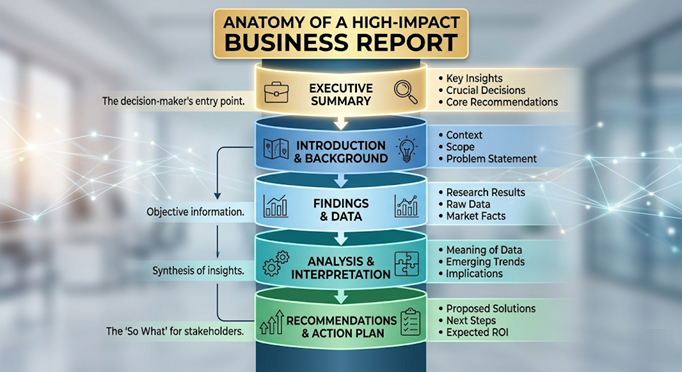
The Impact of Clarity on Career Trajectory
Communication is often labeled a “soft skill,” but in the context of report writing, it is a “hard” technical requirement. Graduates who excel at writing reports often find themselves on a faster track to promotion. Why? Because they make their managers’ lives easier.
When a junior staff member submits a report that is logically sound, visually clear, and free of fluff, they prove they understand the company’s objectives. They demonstrate “Information Gain”—providing new, useful insights rather than just repeating what is already known. This builds trust. Over time, that trust translates into more significant responsibilities and a seat at the table where the real strategy is formed.
Avoiding the “Fluff” Trap
One of the biggest hurdles for undergraduates is unlearning the habit of “word count padding.” In university, students sometimes use complex jargon to sound more academic. In the business world, brevity is prized. Every sentence must serve a purpose. If a word doesn’t add value to the decision-making process, it should be deleted.
To write like a professional, focus on “active” language. Instead of saying, “It was observed that there was a decrease in sales,” say, “Sales decreased by 15%.” This directness conveys confidence and clarity, two traits that are highly valued in any global business environment.
Understanding the Global Business Tone
In an interconnected world, your report might be read by a stakeholder in London, a developer in Bangalore, and a marketing lead in New York. A “Global Tone” means avoiding regional idioms or overly academic metaphors that might get lost in translation. It favors logic over flair.
When you write for a global audience, your structure must be bulletproof. Using universal formatting—such as numbered lists for recommendations and clearly labeled appendices—ensures that the core message remains intact regardless of the reader’s primary language or cultural background. This universality is what separates a student project from a professional business asset.
The Role of Critical Thinking and Synthesis
Report writing is essentially an exercise in critical thinking. It requires the writer to look at a vast sea of information, identify the most relevant data points, and synthesize them into a coherent path forward. This process forces you to confront biases and look at the “hard truths” of a business situation.
For example, a marketing report shouldn’t just celebrate a successful campaign; it should critically analyze why certain demographics didn’t engage and what the cost-per-acquisition looks like compared to industry benchmarks. This level of honesty and depth is what senior leadership looks for when identifying future leaders.
Conclusion
For the ambitious business graduate, report writing is the bridge between being a student and being a professional. It is a skill that requires practice, a sharp eye for detail, and an understanding of the audience’s needs. By prioritizing this skill now—and utilizing the right resources to master it—you aren’t just finishing an assignment; you are building the foundation of a successful career. Success in business isn’t just about what you know; it’s about how effectively you can communicate that knowledge to the people who make the decisions. Building this muscle early is the best investment you can make in your future professional self.
Frequently Asked Questions
1. Is report writing different across different industries?
Ans: While the core principles of clarity and structure remain the same, the focus changes. A financial report emphasizes quantitative data, while a marketing report focuses on consumer behavior and trends. However, the use of headings and executive summaries is universal.
2. How can I improve my report writing skills while still at university?
Ans: Focus on your feedback. Don’t just look at the grade; look at where the professor noted a lack of structure or clarity. Additionally, reading real-world annual reports from companies like Apple or Tesla can give you a feel for professional formatting and “Information Gain.”
3. Why do employers value this skill so highly?
Ans: Employers value report writing because it proves a candidate can think critically. It shows you can take a mountain of raw information, analyze it, and turn it into a plan of action. It is the ultimate proof of a graduate’s utility and “ready-to-work” status.
4. Can visual aids really make that much of a difference?
Ans: Absolutely. A well-placed chart can explain in five seconds what might take five paragraphs to describe. In business, saving time is the same as saving money. Visuals also help in breaking up dense text, making the document more readable.
About The Author
I am Jack Williams, a Senior Content Strategist and Academic Consultant at MyAssignmentHelp. With over a decade of experience in the educational sector, I specialize in helping university students bridge the gap between complex academic theories and practical, career-ready applications.
